Why South African Dairy Farmers and Feedlots Look at Protein Grass
South Africa’s pasture-based dairies already understand cool-season forage: they sow annual ryegrass and clover every autumn and manage grazing rotations closely. Protein Grass offers a pre-blended, higher-protein alternative at a competitive landed cost. Farmers, feedlots and seed distributors in KZN, the Eastern Cape, the Western Cape and the interior consider it because:
- More milk than ryegrass-only pasture — Ryegrass alone runs 15-20% crude protein; Protein Grass delivers 26-38% crude protein, and farmers report 2-5 kg more milk per cow per day within 20-25 days.
- Autumn sowing, winter production — Sow March-May when daytime temperatures fall to 28°C or below; first cut or grazing at 45 days, then every 20-25 days through winter into spring.
- Cuts the concentrate bill — Farm reports show 2-5 kg more milk per cow per day within 20-25 days and roughly half the purchased concentrate — the largest cost on a South African dairy after land.
- Feedlot and sheep green-chop — 700-800 g daily gain in fattening cattle and sheep on green chop; a useful winter option for Free State, North West and Gauteng feedlots under pivot.
- DALRRD-ready documentation — Every consignment ships with the phytosanitary certificate and Certificate of Analysis required under the Agricultural Pests Act and the Plant Improvement Act for seed imports.
- Trial from 500 kg — Seed merchants, study groups and larger farms can trial 20 hectares before committing to container volumes.
The South African Forage Market: Pasture Dairy, Feedlots and Winter Fodder
South Africa produces over three billion litres of milk a year, increasingly from pasture-based systems in the coastal regions where irrigated ryegrass, kikuyu and clover pastures are the norm, alongside TMR systems in the interior. Winter feed is the bottleneck for both: pasture growth slows, hay and silage prices rise, and concentrate is imported at world prices. Feedlots in the Free State, North West and Gauteng and sheep farmers across the Karoo and Free State face the same winter gap.
Improved winter forage is a well-established purchase in South Africa, sold through seed companies, cooperatives and agents. Protein Grass enters that channel as a high-protein, pre-blended option with a short cutting cycle. Kohenoor International prepares the phytosanitary certificate, Certificate of Analysis and origin documents the Department of Agriculture, Land Reform and Rural Development (DALRRD) requires, supports importers with the import permit under the Agricultural Pests Act and any Plant Improvement Act registration for resale, and ships FOB Karachi to Durban or Cape Town in 18-24 days.
Applications for Kohenoor Protein Grass in South Africa
Pasture Dairy
KZN Midlands, Tsitsikamma, Eastern Cape coast
Autumn-sown winter pasture
Pasture-based dairies replacing or supplementing ryegrass-clover with a higher-protein blend.
Recommended: 25 KG bags, 500 KG+
Western Cape Dairy
Swartland, Overberg, Garden Route
Rain-fed winter growth
Winter-rainfall dairies sowing in autumn for winter and spring milk.
Recommended: 25 KG bags
Feedlots & Green Chop
Free State, North West, Gauteng
700-800 g daily gain under pivot
Feedlots growing high-protein green chop or silage under irrigation for winter rations.
Recommended: 25 KG bags, jumbo bags
Sheep & Lamb Finishing
Free State, Karoo, Eastern Cape
Winter fodder for finishing
Sheep farmers finishing lambs on high-protein winter fodder.
Recommended: 10-25 KG bags
Seed Merchants & Cooperatives
Nationwide agri-retail
Private-label packs, Plant Improvement Act support
Seed companies and co-ops adding a high-protein winter blend to their range.
Recommended: Branded 10-25 KG packs
Smallholder & Emerging Farmers
KZN, Eastern Cape, Limpopo
Small plots, cut-and-carry
Development programmes and emerging dairy farmers on smaller irrigated plots.
Recommended: 5-10 KG bags via distributors
Opsomming in Afrikaans: Kohenoor Protein Grass saad vir Suid-Afrika
Kohenoor Protein Grass is ’n hoë-proteïen wintervoermengsel wat vir een uitkoms ontwerp is: meer melk en meer vleis van dieselfde grond. Dit lewer 26-38% ru-proteïen, ’n eerste snit of beweiding 45 dae na saai en daarna elke 20-25 dae vir 5-10 snitte. Saai 25 kg/ha in die herfs (Maart-Mei) wanneer dagtemperature 28°C of laer is. Boere rapporteer 2-5 kg meer melk per koei per dag binne 20-25 dae, 700-800 g daaglikse massatoename by afrondingsdiere, en ongeveer die helfte minder kragvoer. Kohenoor International (sedert 1957) verskeep FOB Karachi na Durban of Kaapstad in 18-24 dae met DALRRD-gereed dokumente; minimum bestelling 500 kg. Kontak: WhatsApp +92-310-4929292 of export@kohenoorint.com.
Kohenoor Protein Grass Specifications
| Parameter | Specification |
|---|
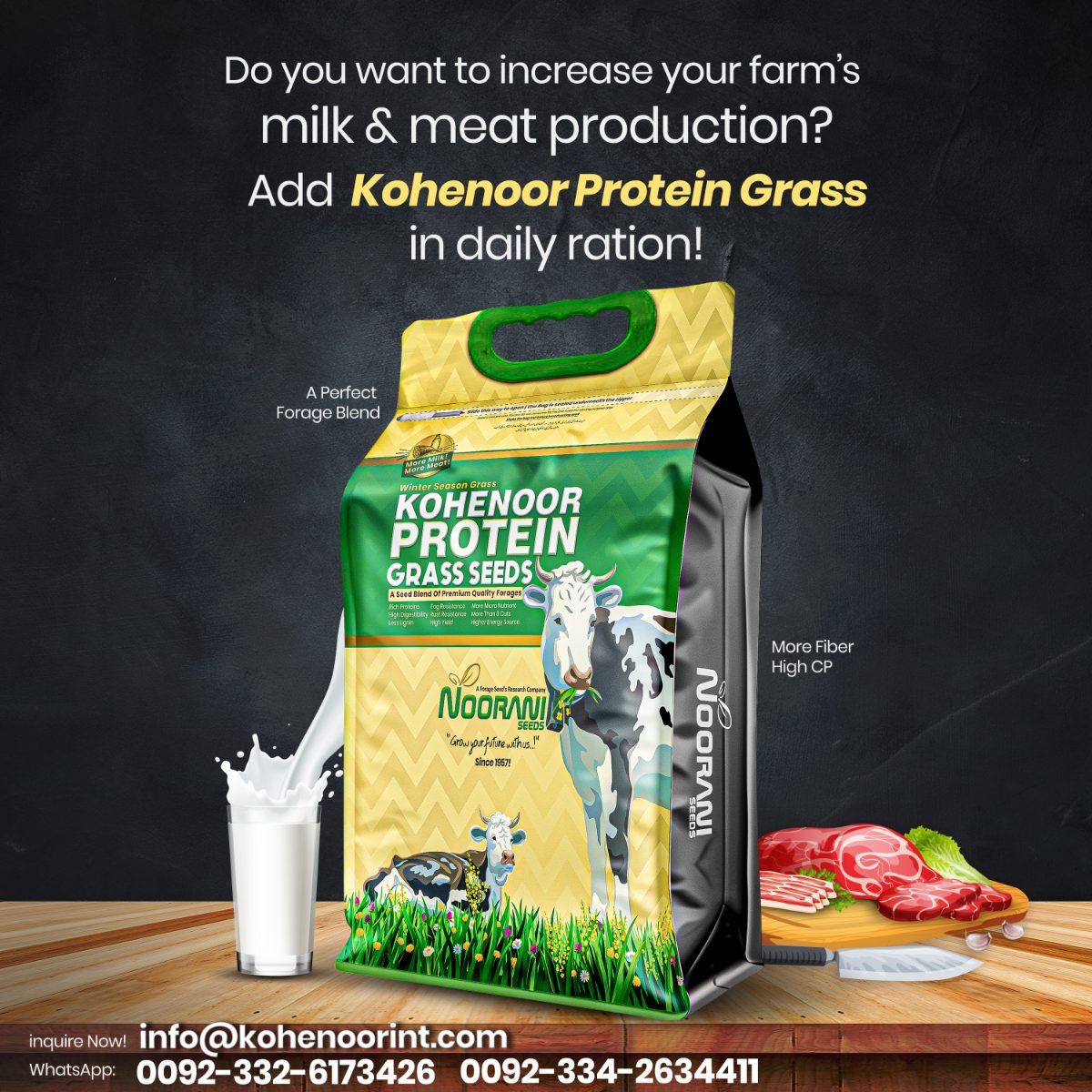
| Product | Kohenoor Protein Grass — “More Milk, More Meat” proprietary high-protein forage seed blend, developed by Noorani Seeds (Kohenoor group) with premium seed lines imported from Germany and blended in Pakistan. Formulation is proprietary; performance is specified below. |
| Crude Protein | 26-38% (cumulative CP of all forages in the blend, not one species) |
| Crude Fibre | 26% maximum |
| Mineral Content | ~10% |
| Dry Matter | ~45% |
| Purity | 98% minimum |
| Germination | 85% minimum |
| Moisture | ≤12% |
| Seed Rate | 10 kg per acre (25 kg/ha); 12-15 kg per acre on light or sandy soils |
| Sowing Window | When daytime temperature is 28°C or below: Sept-Dec in warm lowlands, until March in cooler zones, year-round in cool highlands (1,500 m+) |
| Cutting Schedule | First cut 45 days after sowing, then every 20-25 days; cut 10 cm (4 in) above ground for fast regrowth |
| Number of Cuts | 5-10 per stand depending on sowing date and climate |
| Fresh Yield | About 10-12 t per acre per cut (25-30 t/ha) under good management |
| Fertiliser Guide | DAP 50 kg/acre at sowing (SSP/MAP on light soils); urea 60-100 kg/acre after the first cut, then ~50 kg after each cut |
| Packaging | 5 KG (half acre), 10 KG (one acre) and 25 KG bags; jumbo bags for projects |
| MOQ | 500 KG |
| Incoterms | FOB Karachi / CFR / CIF |
| Documents | Phytosanitary Certificate + Certificate of Analysis (purity, germination, moisture) with every shipment |
Shipping & Logistics: Karachi to South Africa
We load at Karachi Port (KICT / SAPT). Bagged seed ships on pallets; services connect Karachi with South Africa’s main gateways directly or via a Middle East hub:
| Destination Port | Typical Transit Time | Serves |
|---|
| Durban | 18-22 days | KwaZulu-Natal, Free State, Gauteng, Eastern Cape by road |
| Cape Town | 20-24 days | Western Cape and Garden Route dairies |
| Gqeberha (Port Elizabeth) / Ngqura | 20-24 days | Eastern Cape, Tsitsikamma |
| Air freight to OR Tambo (Johannesburg) | 5-7 days | Samples and urgent small lots |
Documentation for DALRRD and South African Customs Clearance
Seed imports into South Africa require an import permit from the Department of Agriculture, Land Reform and Rural Development (DALRRD) under the Agricultural Pests Act, a phytosanitary certificate, and customs clearance through SARS; seed sold commercially is subject to the Plant Improvement Act. Every Kohenoor consignment to South Africa includes:
- Phytosanitary Certificate — issued by Pakistan’s Department of Plant Protection to the conditions on your DALRRD import permit, declaring freedom from quarantine pests and weed seeds
- Certificate of Analysis — purity, germination, moisture and inert matter per lot, plus the blend performance specification (crude protein, crude fibre, minerals, dry matter); ISTA format on request for Plant Improvement Act purposes
- Certificate of Origin — attested by the Hyderabad Chamber of Commerce
- Commercial invoice, packing list and Bill of Lading — consistent product description (forage seed mixture, HS 1209.29), lot numbers and net weights for the SARS declaration
- Importer support — we align documents with your DALRRD permit and coordinate with your clearing agent at Durban or Cape Town before arrival
How Importers in South Africa Order From Us
- Step 1 — Enquiry & Quote: Send your target specification, volume, and destination port via our order page or WhatsApp. We respond with a firm FOB Karachi / CFR / CIF quotation within 24 hours, valid for a stated period against current crop pricing.
- Step 2 — Sample Approval: We courier a representative sample to your facility or laboratory in South Africa so you can verify the lot against the Certificate of Analysis before committing.
- Step 3 — Contract & Payment: We issue a proforma invoice covering quantity, specification, packing, Incoterms, and payment terms (T/T or irrevocable LC at sight). Processing and container booking begin on confirmation.
- Step 4 — Shipment & Documents: Container stuffed, sealed, and loaded at Karachi; the complete document set is couriered or released per agreed terms before arrival at your port in South Africa.
Why Kohenoor International
South African buyers benchmark every forage seed on data. Kohenoor International supplies lot-level analysis, trial quantities and a product proven on thousands of Pakistani dairy farms each season, and already serves South African and Southern African buyers with alfalfa and Rhodes grass seed.
- Exporting Since 1957 — Nearly seven decades of continuous agricultural export experience from Hyderabad, Sindh, across three generations of the business.
- 70+ Countries Served — Our seeds, herbs, spices, and Himalayan salt ship to buyers in more than 70 countries across five continents.
- ISO 9001:2015 + HACCP Certified — Documented quality management and food-safety controls across sourcing, processing, and packing.
- 60+ Product Portfolio — Alfalfa, Rhodes grass, berseem, sesame, fennel, fenugreek, Himalayan salt, and dozens more — consolidate several products into one container from one audited supplier.
- Industry Memberships — Hyderabad Chamber of Commerce, Rice Exporters Association of Pakistan (REAP), and the International Seed Federation (ISF).
- Full Traceability & Testing — Every lot is lab-tested and shipped with a Certificate of Analysis; samples are couriered before you commit.
Frequently Asked Questions — Kohenoor Protein Grass to South Africa
When should Protein Grass be sown in South Africa?
In autumn, March to May, when daytime temperatures fall to 28°C or below, for winter and spring production; in the winter-rainfall Western Cape sow with the first rains. Under irrigation in cooler highland areas it can also be sown in late summer.
How much seed per hectare and how is it grazed or cut?
25 kg per hectare on good soils, 30-37 kg on light soils. First cut or grazing at 45 days, then every 20-25 days; cut or graze to 10 cm and rest the stand for regrowth, for 5-10 cuts.
How does it compare with annual ryegrass and clover pasture?
It is a pre-formulated high-protein alternative for the same autumn-sown winter slot, with 26-38% crude protein and a short regrowth cycle. Farms that trial it alongside their existing ryegrass-clover mix compare milk per hectare and daily gain — that is the number Protein Grass is built to win.
What is the minimum order and shipping time to Durban?
MOQ is 500 kg (20 hectares) in 5, 10 or 25 kg bags, shipped FOB Karachi or CFR/CIF Durban or Cape Town in 18-24 days. Seed merchants and larger farms typically order 1-5 MT; volume pricing applies from 2 MT.
What permits are needed to import forage seed into South Africa?
The importer obtains a DALRRD import permit under the Agricultural Pests Act before shipment; seed sold commercially must also comply with the Plant Improvement Act. Our phytosanitary certificate, Certificate of Analysis and origin documents are prepared to match the permit and support registration.