Quick answer
Sesame seeds come from the sesame plant (Sesamum indicum), a 1-2 metre annual grown in hot, dry climates. The seeds form inside pods (capsules) along the stem, are harvested when the pods ripen and are dried, threshed, cleaned and graded. Most of the world’s sesame is grown in Sudan, India, Myanmar, Tanzania, Nigeria, China and Pakistan.
Where Do Sesame Seeds Come From?
Sesame seeds come from the sesame plant, a flowering annual known to botanists as Sesamum indicum. The tiny, oval seeds that top your burger buns, blend into tahini, and press into golden oil all begin their life inside slender seed pods called capsules, which grow along the stem of a leafy plant that can stand taller than a person. In other words, sesame is not a nut, a grain, or a manufactured product — it is the harvested seed of a real crop grown by farmers across the warm belt of the world.
We have been asked "where do sesame seeds come from?" by buyers, chefs, and curious visitors for as long as we have been in the trade — and at Kohenoor International, that trade reaches back to 1957. In the pages below we will walk you through the plant itself, its remarkable history, how it is grown and harvested, where it is cultivated today, the difference between white, black, and hulled sesame, and how the seed travels from a dusty field to a sealed export bag graded to 99.98% purity. This is the plain-language, field-to-export explanation we wish more people could find.
The Sesame Plant (Sesamum indicum)
The plant that produces sesame seeds is Sesamum indicum, a member of the Pedaliaceae family. It is an erect, warm-season annual that typically grows 60 to 120 cm (2 to 4 feet) tall, though under good conditions some varieties push past 1.5 to 2 metres. The stems are square-ish and often covered in fine hairs, the leaves are lance-shaped, and from the leaf axils the plant sends out beautiful bell-shaped tubular flowers — white, pale pink, or soft purple — that look strikingly like foxgloves.
Once a flower is pollinated, it develops into the part that matters most for us: the seed capsule. Each capsule is an elongated, grooved pod, roughly 2 to 5 cm long, divided internally into compartments packed with seeds. A single capsule holds somewhere between 50 and 100 seeds, and a healthy plant carries dozens of capsules. As the capsule ripens, it turns from green to straw-brown, dries, and then splits open along its seams to release the seed — a dramatic little event that gave the world one of its most famous phrases.
"Open sesame" — the magic command from the tale of Ali Baba — is widely believed to draw on the way a ripe sesame capsule suddenly bursts open to spill its seeds, as if a hidden door had sprung apart.
Is Sesame a Plant or a Seed?
It is both, and the confusion is understandable. "Sesame" is the name of the plant growing in the field, and "sesame seeds" are the edible seeds harvested from that plant's capsules. When a farmer talks about their sesame crop, they mean rows of green Sesamum indicum; when a baker talks about sesame, they mean the small cream-coloured seeds in a jar. Same organism, two stages of the same story.
A Short History: One of the World's Oldest Oilseed Crops
Sesame is not a modern discovery. It is, in fact, one of the oldest oilseed crops known to humanity. Archaeological and genetic evidence points to domestication of Sesamum indicum on the Indian subcontinent, with charred sesame remains recovered from sites of the Indus Valley Civilisation dating back roughly 5,500 years. That places the birthplace of cultivated sesame squarely in the region that is today Pakistan and northwest India — a heritage we at Kohenoor are proud to carry forward from our home in Sindh.
From that cradle, sesame spread along ancient trade routes into Mesopotamia, Egypt, and Africa, and eastward across Asia. The Assyrians and Babylonians pressed it for oil and lamp fuel; Egyptian tombs record it as a food and medicine; and because the plant tolerates heat and drought where other crops fail, it became a dependable staple across arid lands. For thousands of years, sesame oil was one of the most important vegetable oils in the world — valued precisely because the seed is so rich in oil and so resistant to going rancid.
The Pakistan Connection
Because sesame was domesticated in the Indus Valley, the fields of modern-day Sindh and Punjab sit on some of the oldest continuously cultivated sesame ground on Earth. The region's long, hot growing season and alluvial soils produce bright, plump, high-oil white seed — the reason Pakistani sesame is a mainstay of the tahini and confectionery trade. Kohenoor International has exported this heritage crop since 1957.
How the Sesame Plant Is Grown
Sesame earns its reputation as a "survivor" crop. It is remarkably drought-tolerant, thrives in heat that would scorch more delicate plants, and grows well on marginal soils where irrigation is limited. This is exactly why smallholder farmers across Asia and Africa have relied on it for generations: it asks for little and gives a valuable, storable, high-value seed in return.
Climate, Soil and Sowing
Sesame is a short-day, warm-season plant that needs consistent warmth — ideally daytime temperatures of 25 to 35°C throughout its growth. It is sensitive to frost and waterlogging, so it is planted after the danger of cold has passed and grown on well-drained, sandy-loam soils. Farmers sow the small seeds shallowly into a warm seedbed, often broadcasting or drilling them, and the plants emerge within a few days. Because the seed is so fine, a light, firm, weed-free seedbed makes all the difference to establishment.
The 90-to-120-Day Cycle
From sowing to harvest, sesame runs a fairly quick 90 to 120 day cycle, depending on variety and climate. The plant grows vegetatively, then flowers over an extended period, setting capsules from the bottom of the stem upward. This staggered ripening is a blessing and a curse: the lower capsules mature and dry while the top of the plant is still flowering, which means the whole crop is rarely ready at the exact same moment. Judging the right harvest window is a skill farmers develop over many seasons.
Why Capsule Shattering Matters
Here is the single most important agronomic fact about sesame: most traditional varieties are dehiscent, meaning their ripe capsules shatter — split open and drop their seed — the moment they are dry. Left in the field a few days too long, a crop can literally spill much of its value onto the ground. This shattering trait is wonderful for a wild plant that wants to reproduce, but it is the central headache of sesame farming and the reason so much of the world's sesame is still harvested by hand at a carefully judged moment. Plant breeders have worked for decades to develop non-shattering (indehiscent) varieties that hold their seed long enough for machines to gather it.
How Sesame Is Harvested
Harvest is where tradition and technology diverge most sharply.
Hand Harvesting
Across much of Asia and Africa — including large parts of Pakistan — sesame is still harvested by hand. Farmers watch for the lower capsules to turn brown and the leaves to yellow, then cut the plants near the base, tie them into bundles or upright "stooks," and stand them to dry in the sun. As the capsules dry and begin to split, the bundles are turned upside down and beaten or shaken over cloths, tarpaulins, or threshing sheets so the seed rains out. The process is often repeated over several days as more capsules open. It is labour-intensive but gentle, and it keeps field losses low when timing is good.
Mechanical Harvesting
In large-scale operations — and increasingly with modern non-shattering varieties — sesame is combine-harvested like other field crops. This dramatically cuts labour but demands varieties bred to retain their seed until the machine passes through. Where shattering types are grown, mechanical harvest can mean unacceptable seed loss, which is why variety choice and harvest timing are so tightly linked in this crop.
Where Sesame Grows Today
Sesame is cultivated across a wide tropical and subtropical belt. A handful of countries dominate global supply, each with its own reputation among buyers:
- Sudan — a top exporter, famed for aromatic white and reddish seed favoured in oil and tahini.
- India — a huge producer offering an enormous range of grades and colours, including black sesame.
- Myanmar — one of the largest producers by volume, supplying much of the Asian market.
- Tanzania — a major and fast-growing African origin known for bold, high-oil seed.
- Pakistan — the ancestral home of the crop, whose Sindh and Punjab harvests yield bright, uniform, high-oil white sesame prized by the tahini and confectionery trade.
Other significant origins include Nigeria, Ethiopia, China, Uganda, and Mexico. Because sesame quality depends on variety, soil, weather, and — crucially — how well the seed is cleaned and sorted after harvest, no single origin is "best" for every use. What we can say from six decades of exporting is that well-processed Pakistani white sesame stands with the finest in the world, especially where brightness, uniformity, and oil content matter.
White vs Black vs Hulled Sesame
Buyers often ask us to explain the different types of sesame on the market. The three most common categories are white (natural), black, and hulled sesame. Here is how they compare:
| Type | Description | Common Uses |
|---|---|---|
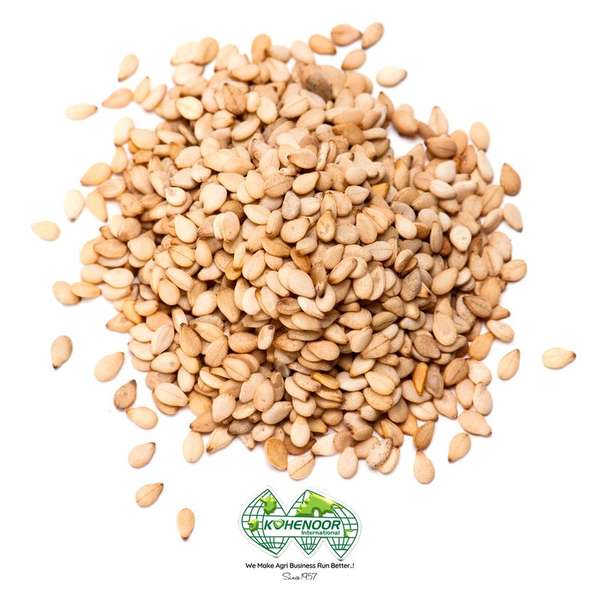
| White (Natural) | Seed with its intact cream-to-tan seed coat; naturally pale varieties. High oil content, mild nutty flavour. | Tahini, oil pressing, bakery toppings, confectionery, halva |
| Black | Varieties with a naturally black seed coat; stronger, more intense flavour and slightly more bitter, earthy notes. | Garnishing, East Asian cuisine, gomashio, sesame paste, health foods |
| Hulled (White/Polished) | White sesame with the outer seed coat mechanically removed, leaving a bright, uniform ivory seed. | Premium bakery, sushi, tahini for pale pastes, high-visual-grade toppings |
A few points worth remembering: hulling removes the fibrous outer coat to produce a brighter, softer, less bitter seed — but it also removes some of the calcium and fibre held in that coat. Natural (unhulled) white sesame keeps more of those nutrients and a fuller flavour, which is why many tahini and oil buyers prefer it. Black and white sesame are different varieties, not the same seed at different stages, and they are usually grown, graded, and priced separately.
From Field to Export: Cleaning, Sorting and Quality
Raw sesame straight off the threshing sheet is never export-ready. It arrives mixed with dust, chaff, stones, immature seed, and the occasional off-colour grain. Turning that raw lot into a food-grade export product is a precise, multi-stage process — and it is where a serious processor earns its reputation.
At Kohenoor, the journey looks like this:
- Pre-cleaning & de-stoning — sieves, air aspiration, and gravity separators remove dust, stalks, stones, and light impurities.
- Washing & drying (where required) — the seed is cleaned and brought down to a safe, stable moisture level for storage.
- Sortex colour sorting — optical Sortex machines scan the seed grain-by-grain and eject anything off-colour or defective, delivering exceptional uniformity.
- Grading & final QC — the lot is graded and tested against agreed quality parameters, reaching purity levels up to 99.98%.
- Packing & export — the finished seed is packed to specification and shipped FOB Karachi to buyers worldwide.
Typical quality parameters buyers specify include purity, oil content, moisture, admixture, and FFA (free fatty acid) level, all documented before shipment. As an ISO 9001:2015 and HACCP certified exporter shipping to 70+ countries, we treat every lot as traceable and every specification as a promise.
Source Premium Sesame Seeds from Pakistan
Kohenoor International has exported natural, hulled, and black sesame seeds since 1957. Sortex-cleaned to 99.98% purity, ISO 9001:2015 and HACCP certified, with full quality documentation. FOB Karachi and flexible shipping terms to 70+ countries.
Request a Quote →How Sesame Is Used Around the World
Few crops are as versatile as sesame. Because the seed is roughly 50% oil and packed with flavour, it feeds a huge range of food traditions:
- Tahini — the smooth ground-sesame paste at the heart of hummus, halva, and Middle Eastern cuisine.
- Sesame oil — pressed from the seed's ~50% oil content; light oil for cooking and dark toasted oil for East Asian flavour.
- Bakery & confectionery — buns, breads, crackers, biscuits, and sweets such as halva and sesame brittle.
- Gomashio — the Japanese toasted-sesame-and-salt condiment sprinkled over rice and vegetables.
- Health foods — whole seeds and sesame products valued for oil, protein, calcium, and antioxidants.
From a Karachi export bag to a Beirut tahini mill, a Tokyo kitchen, or a European bakery line, the humble sesame seed — grown on a plant first domesticated near our own doorstep more than five thousand years ago — remains one of the most widely traded and best-loved seeds on Earth.
Frequently Asked Questions About the Sesame Plant
Is sesame a plant or seed?
Both. Sesame (Sesamum indicum) is a flowering annual plant, and the sesame seeds we eat are the edible seeds it produces inside pods called capsules. Each capsule holds roughly 50 to 100 small oval seeds. So "sesame" can mean the growing plant in the field or the harvested seed used in food.
What does the sesame plant look like?
The sesame plant is an erect, leafy annual, usually 60 to 120 cm (2 to 4 feet) tall, with hairy stems, lance-shaped leaves, and bell-shaped tubular flowers in white, pink, or pale purple that resemble foxgloves. After flowering it forms elongated grooved seed capsules that turn from green to brown and split open when dry to release the seeds.
Which country produces the best sesame seeds?
There is no single "best" origin for every use. Pakistan (Sindh and Punjab) is prized for bright, uniform, high-oil white sesame favoured by tahini and confectionery buyers; Sudan for aromatic seed; India for a wide range of grades; and Myanmar and Tanzania for large volumes. Quality comes down to variety, soil, cleaning, and sorting — well-cleaned Pakistani sesame graded to 99.98% purity competes with the best in the world.
Why do sesame capsules shatter?
Most traditional sesame varieties are dehiscent: their capsules naturally split open along the seams when they dry, an evolutionary trait that scatters seed to reproduce — and the likely origin of "open sesame." Shattering makes mechanical harvesting difficult because seed is lost if the crop is cut too late, which is why much sesame is still hand-harvested and why non-shattering varieties have been bred for machine harvest.
How are sesame seeds harvested?
Sesame is harvested about 90 to 120 days after sowing, when the lower capsules ripen and leaves yellow. Traditionally, plants are cut by hand, tied into bundles, and dried so the capsules open; the bundles are then inverted and beaten over sheets to release the seed. In large mechanised systems, non-shattering varieties are combine-harvested. The seed is then dried, cleaned, Sortex-sorted, and graded before export.