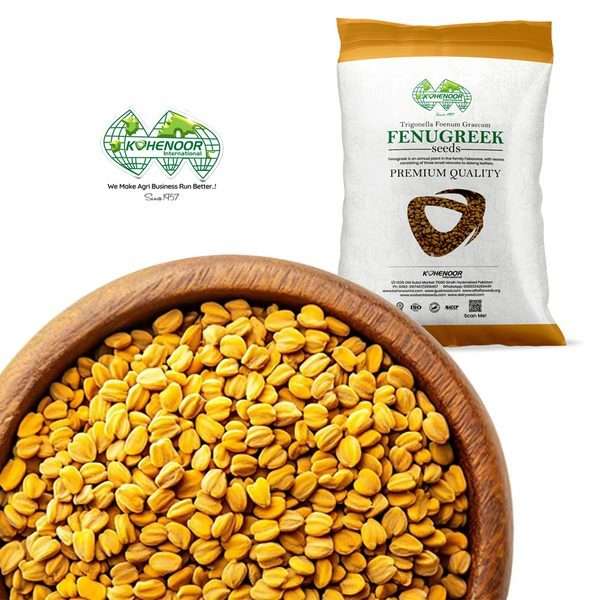
Fenugreek vs Fennel: The Short Answer
Fenugreek (Trigonella foenum-graecum) and fennel (Foeniculum vulgare) are both called “seeds”, both sit side by side in South Asian spice boxes, and both start with the letter F — which is where the similarity ends. Fenugreek is a legume with small, hard, angular yellow-brown seeds that taste bitter and smell like maple syrup or burnt sugar. Fennel is a member of the carrot family with plump, ridged, greenish seeds that taste sweet and taste strongly of anise or liquorice. They are not interchangeable in recipes, they are grown and processed differently, and they are traded under different customs headings.
This guide compares the two plants across botany, flavour, culinary use, nutrition, cultivation, export grades and pricing — so that cooks, spice brands and bulk importers can choose the right seed for the job.
Botany: A Legume and an Umbellifer
Fenugreek (Trigonella foenum-graecum)
Fenugreek belongs to the Fabaceae — the pea and bean family. The plant grows 30-60 cm tall with trifoliate leaves like clover, small white to pale-yellow flowers, and slender curved pods 5-10 cm long. Each pod holds 10-20 seeds. The seeds are 3-5 mm, hard, rhomboid with a deep groove, and range from mustard-yellow to amber-brown. In South Asia the fresh leaves are eaten as the vegetable methi, and the plant is also grown as a nitrogen-fixing green manure and fodder crop.
Fennel (Foeniculum vulgare)
Fennel belongs to the Apiaceae — the carrot, celery and parsley family — alongside cumin, coriander and anise. It is a tall, feathery perennial (grown as an annual for seed) reaching 1-2 m, with hollow stems and yellow flowers in flat-topped umbels. The “seeds” are technically dried fruits: oval, 4-8 mm, ridged, greenish-yellow to grey-brown, sometimes with a short stalk attached. A separate cultivar, Florence fennel, is grown for its bulb rather than seed.
| Feature | Fenugreek seeds | Fennel seeds |
|---|---|---|
| Botanical name | Trigonella foenum-graecum | Foeniculum vulgare |
| Plant family | Fabaceae (legume) | Apiaceae (carrot family) |
| Seed shape and size | Angular, grooved, 3-5 mm | Oval, ridged, 4-8 mm |
| Colour | Yellow to amber-brown | Green-yellow to grey-brown |
| Aroma / flavour | Bitter, maple, burnt sugar | Sweet, anise, liquorice |
| Key aroma compound | Sotolon | Anethole (essential oil 1-6%) |
| Hindi / Urdu name | Methi | Saunf |
| HS heading | 0910.99 | 0909.61 / 0909.62 |
Flavour and Aroma: Bitter-Maple vs Sweet-Anise
The chemistry explains the difference. Fenugreek’s signature aroma comes from sotolon, the same molecule that gives maple syrup, aged sake and lovage their character; its bitterness comes from saponins and alkaloids that soften with dry-roasting or soaking. Raw fenugreek is pungent and bitter; toasted briefly in oil it turns nutty and caramel-like, but over-toasted it becomes acrid, which is why recipes specify only a few seconds in hot oil.
Fennel’s aroma is dominated by anethole, the compound shared with anise and star anise. It is sweet, cooling and slightly camphorous, with a natural sweetness roughly 13 times that of sugar by weight in pure form. Fennel seed is pleasant raw — which is why it is chewed after meals across South Asia and the Middle East — and becomes warmer and rounder when toasted.
Culinary Uses Compared
Where fenugreek is used
- Indian and Pakistani cooking: tempering (tadka) for dals and vegetable dishes, pickles (achar), sambar powder, Bengali panch phoron, and the dried leaf kasuri methi that finishes butter chicken.
- Middle East and Africa: Yemeni hilbeh paste, Ethiopian berbere, Egyptian and Turkish spice blends, and Persian ghormeh sabzi.
- Food industry: artificial maple flavouring, curry powders, and as a galactomannan gum source for thickening.
- Sprouting and micro-greens: fenugreek sprouts are eaten in salads and are a fast-growing sprouting seed.
Where fennel is used
- South Asia: mukhwas (after-meal digestive mix, often sugar-coated), tea and saunf water, and also in panch phoron alongside fenugreek.
- Europe: Italian sausage, porchetta, taralli and rye breads; French and Provencal fish dishes; fennel tea in Germany and Scandinavia.
- China: one of the classic ingredients of five-spice powder.
- Beverages and confectionery: absinthe, pastis and Italian liqueurs, plus herbal teas, throat lozenges and toothpaste flavouring.
Can you substitute one for the other?
No. Fennel can stand in for anise or caraway; fenugreek has no close substitute, though a pinch of mustard seed plus a drop of maple syrup approximates it in a pinch. The one place they legitimately appear together is Bengali panch phoron — equal parts fenugreek, fennel, nigella (kalonji), cumin and mustard seed — which is also a useful reference when a spice brand wants to source all five from one exporter.
Nutrition and Traditional Uses
Fenugreek seed is unusually nutrient-dense for a spice: around 23% protein, 25% dietary fibre (much of it soluble galactomannan), and meaningful iron, magnesium and manganese. It has a long history in Ayurvedic and Unani medicine, and modern research has examined its soluble fibre for effects on post-meal blood sugar and its traditional use to support milk supply in nursing mothers. Results are promising but not conclusive; anyone using it for a health purpose should discuss it with a healthcare professional, particularly people taking diabetes medication or during pregnancy.
Fennel seed supplies fibre, calcium, potassium and a volatile oil rich in anethole. Its traditional reputation is digestive: fennel tea is used for bloating and colic in many cultures, and fennel is a common ingredient in herbal preparations for infants and nursing mothers. Anethole has also been studied for antimicrobial and antispasmodic activity. As with fenugreek, culinary amounts are safe for almost everyone; concentrated extracts and essential oils are a different matter and should be used under guidance.
Cultivation and Harvest in Pakistan
Both crops are winter (rabi) crops in Pakistan, sown from October to November and harvested from March to May — a timing advantage for northern-hemisphere buyers who want fresh-crop seed in the second quarter.
Fenugreek is grown across Punjab and Sindh on loamy soils with light irrigation. As a legume it fixes its own nitrogen, so input costs are low. Plants are cut when pods turn yellow-brown, sun-dried, threshed and winnowed. Yields of 1-1.5 tonnes of seed per hectare are typical.
Fennel is grown in Punjab, Sindh and parts of Balochistan and Khyber Pakhtunkhwa, favouring cooler dry weather during seed set. Umbels are harvested in stages as they mature, dried in shade to preserve the green colour and volatile oil, then threshed. Well-managed crops yield 1-2 tonnes per hectare. Green colour and oil content are the two quality factors that separate premium fennel from ordinary grades.
Export Grades and Specifications
Buyers sourcing either seed in bulk should specify quality in numbers. Typical export specifications from Kohenoor International are:
| Parameter | Fenugreek seeds | Fennel seeds |
|---|---|---|
| Purity (min.) | 99% | 98-99% |
| Moisture (max.) | 10% | 10% |
| Admixture / foreign matter (max.) | 1% | 1-2% |
| Grades | Bold, regular; machine-cleaned, sortex on request | Green (premium), yellow-green, regular; sortex on request |
| Packing | 25 / 50 kg PP or paper bags; jumbo bags | 25 / 50 kg PP or paper bags; jumbo bags |
| Harvest | March - May | March - May |
| Shelf life | 24 months, cool and dry | 12-18 months for best colour and oil |
Full product data, photographs and certifications are on the fenugreek seeds and fennel seeds product pages. Both are shipped with a phytosanitary certificate, certificate of analysis and, where required, pesticide-residue and aflatoxin reports for EU and North American buyers.
Price and Market Comparison
In most seasons fennel trades at a premium to fenugreek per kilogram, because fennel yields are lower, the crop is more weather-sensitive, and premium green grades require careful drying. Fenugreek is one of the most affordable spices in world trade, which makes it attractive for high-volume uses such as curry powders, animal-feed flavouring and gum extraction. Both prices move with the Indian and Pakistani harvest, since the two countries together supply most of the world’s export volume.
For importers, the practical takeaway is that fenugreek is a volume product where cleaning and consistency matter most, while fennel is a quality product where colour, aroma and oil content command the margin. A processor-exporter that handles both can supply matched lots for spice blends and consolidate them in a single container with sesame, ajwain, kalonji and other Pakistani spice seeds.
Which One Should You Buy?
- For curry powders, pickles and South Asian blends: you need both, but fenugreek is the base note; buy bold, low-bitterness lots.
- For tea, confectionery, sausage and five-spice: fennel, ideally green premium grade with high anethole content.
- For sprouting or micro-greens: fenugreek, sourced as clean, untreated seed with high germination.
- For nutraceutical extracts: fenugreek (galactomannan, saponins) or fennel (anethole oil), each with a certificate of analysis for the active fraction.
- For a retail spice line: both, packed at origin in retail pouches or jars to cut re-packing cost.
Whichever you choose, ask for a pre-shipment sample and a certificate of analysis, and buy from a certified exporter that cleans and grades at its own facility. Read more in our guides to fenugreek seed benefits and uses and the complete fennel seed guide, or see how to import seeds from Pakistan for the documentation process.
Buy Fenugreek and Fennel Seeds Direct from Pakistan
Machine-cleaned fenugreek and premium green fennel seed from the 2026 crop. ISO 9001:2015 and HACCP certified, exporting since 1957 to 70+ countries. COA and phytosanitary certificate with every shipment. MOQ from 1 MT. FOB Karachi, CFR and CIF terms.
Request a Quote →Frequently Asked Questions
Are fenugreek and fennel the same thing?
No. Fenugreek (Trigonella foenum-graecum) is a legume with bitter, maple-scented angular seeds; fennel (Foeniculum vulgare) is a carrot-family plant with sweet, anise-flavoured oval seeds. They come from different plant families and are used differently in cooking.
Can I substitute fennel seeds for fenugreek seeds?
Not successfully. Fennel adds sweetness and liquorice notes, while fenugreek adds bitterness and a maple-like depth. Substituting one for the other changes the dish completely. Fennel can replace anise or caraway; fenugreek has no true substitute.
Which is healthier, fenugreek or fennel?
Both are nutritious in culinary amounts. Fenugreek is higher in protein and soluble fibre and has been studied for blood-sugar support; fennel is valued for its digestive volatile oil. Neither should replace medical treatment, and concentrated supplements should be discussed with a healthcare professional.
What is saunf and what is methi?
Saunf is the Hindi/Urdu name for fennel seed, chewed after meals as a digestive and breath freshener. Methi is the name for fenugreek — both the seed and the leafy green vegetable.
Where can I buy fenugreek and fennel seeds in bulk?
Pakistan and India are the largest exporters of both seeds. Kohenoor International supplies machine-cleaned fenugreek and premium fennel seed from its own facility in Hyderabad, Pakistan, with ISO 9001:2015 and HACCP certification, MOQs from 1 metric ton, and FOB Karachi, CFR or CIF terms. Request a quote for current crop pricing.