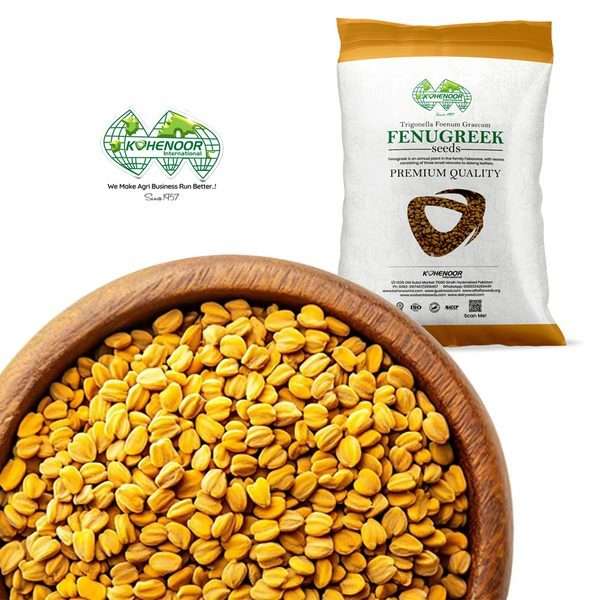
The Short Version
Fenugreek seed (Trigonella foenum-graecum, HS 0910.99) is imported as a spice / food ingredient, not as seed for sowing, so the paperwork is food-safety paperwork: a phytosanitary certificate from Pakistan, a Certificate of Analysis showing pesticide residues, ethylene oxide, aflatoxin and Salmonella results per lot, and a clean, consistent commercial document set. The four big destination blocs — the European Union, the United States, Canada and Brazil — each add their own registration or notification step at the importer’s end. This checklist walks through all four, tells you which document each authority actually looks at, and what Kohenoor International supplies with every container from Karachi.
If you are importing into a specific country, the country guides go deeper: Germany, United Kingdom, Netherlands, France, Italy, Spain, Poland, United States, Canada and Brazil each have a dedicated page with ports, transit times and local-language summaries.
Step 0: What Every Fenugreek Shipment Needs Regardless of Destination
| Document | Issued by | What the authority checks |
|---|---|---|
| Phytosanitary certificate | Department of Plant Protection (DPP), Karachi | Freedom from quarantine pests, weed seeds and soil; treatment declaration |
| Certificate of Analysis (CoA) | Exporter lab + third-party lab (SGS / Intertek / Bureau Veritas) | Purity, moisture, admixture, pesticide-residue panel, ethylene oxide, aflatoxin B1/total, Salmonella in 25 g |
| Certificate of origin | Hyderabad Chamber of Commerce | Origin for tariff treatment and customs valuation |
| Commercial invoice + packing list | Exporter | HS 0910.99, lot numbers, net/gross weights, Incoterm, consignee |
| Bill of lading | Shipping line | Title, container and seal numbers matching the packing list |
| Fumigation certificate (if treated) | Licensed fumigator | Phosphine treatment record; methyl bromide is not used for EU-bound lots |
| Non-GMO / allergen / health declaration | Exporter | Supporting declaration for food-safety files and private label |
The single most common cause of delay at any port is a mismatch between documents: a different consignee name on the phytosanitary certificate, a lot number that appears on the CoA but not the packing list, or a net weight that does not add up across bags. Ask for draft copies of the full set before the container is stuffed — every Kohenoor shipment gets this “document dry run” as standard.
European Union: Regulation 396/2005, Ethylene Oxide and the Official Controls Regime
The EU is the most demanding fenugreek market and the one where the rules changed most in the last five years. Five things matter:
- Pesticide MRLs — Regulation (EC) 396/2005. Fenugreek falls under the spice/seed group of Annex I. The lot must be tested against the EU maximum residue levels for the relevant multi-residue panel; a CoA quoting the laboratory, the method (usually LC-MS/MS and GC-MS/MS) and the EU limit for each analyte is what the border control post and your customer’s QA both want to see. We state results as tested per lot with the CoA supplied — not as a blanket guarantee.
- Ethylene oxide (ETO). Since the 2020-2021 sesame recalls, EU importers test spices and seeds for ethylene oxide and its metabolite 2-chloroethanol. Fenugreek is not on the Annex I list of Regulation (EU) 2019/1793 that forces official ETO controls at the border for Pakistani origin (that list covers sesame and some other products, and it is reviewed every six months — check the current version), but most buyers require an ETO result on the CoA anyway. Kohenoor tests every export lot for ETO.
- Official Controls Regulation (EU) 2017/625 and 2019/1793. Products of non-animal origin from listed countries must be pre-notified through TRACES NT with a Common Health Entry Document (CHED-D) before arrival at the border control post. Whether pre-notification and increased checks apply to your consignment depends on the current Annex I/II listing for fenugreek from Pakistan; your customs broker checks this against the latest amendment. If it applies, the frequency of identity and physical checks (for example 20% or 50%) is set in the annex.
- Aflatoxin and microbiology. Regulation (EU) 2023/915 sets maximum levels for aflatoxin B1 and total aflatoxins in spices; fenugreek lots are tested per lot. Salmonella absence in 25 g is a market requirement; steam-sterilised lots are available on request for ready-to-eat use.
- Labelling and food business registration. The importer must be a registered food business operator; bags carry lot number, net weight, origin and best-before. Private-label bags are printed to your artwork.
Ports and transit: Karachi to Rotterdam, Antwerp or Hamburg is 22-28 days; to Genoa, Barcelona or Marseille 18-24 days; to Gdansk 26-32 days. The Netherlands guide and Germany guide cover the Rotterdam and Hamburg border control posts in detail, and the Poland and Italy pages cover the Baltic and Mediterranean routes.
United Kingdom: Same Science, Separate Notification
Post-Brexit, Great Britain keeps retained versions of the EU MRL and contaminant rules and runs its own high-risk food and feed (HRFNAO) list. Pre-notification goes through IPAFFS rather than TRACES, and consignments land at Felixstowe, London Gateway or Southampton in 22-26 days from Karachi. The document set is identical to the EU set; only the notification portal and the border control post change. The UK fenugreek page lists the current requirements and ports.
United States: FDA Prior Notice, FSVP and APHIS
- Facility registration. The Pakistani exporter’s facility must be registered with the FDA under the Bioterrorism Act and renewed every two years; Kohenoor International holds a current registration, and the number goes on your prior notice.
- Prior Notice. Every food shipment must be pre-notified to the FDA (via ABI/ACE or the Prior Notice System Interface) before arrival — for ocean freight, at least 8 hours before the vessel arrives. Your customs broker files it from the invoice and packing list.
- FSVP — Foreign Supplier Verification Program. The US importer of record is responsible for verifying that the foreign supplier produces food to US safety standards. In practice that means a supplier file: hazard analysis, the exporter’s HACCP plan and ISO 9001:2015 certificate, lab results per lot, and an approved-supplier record. We supply the file in the format FSVP importers use.
- Pesticide tolerances. US tolerances (40 CFR 180) differ from EU MRLs; where no tolerance exists for fenugreek the default is zero, so the multi-residue CoA matters as much as in Europe.
- USDA APHIS. Fenugreek seed imported as a spice does not need an APHIS permit, but the phytosanitary certificate is still required and the consignment must be free of soil and plant debris. If you intend to sell any of it as seed for sowing, the rules change entirely (Federal Seed Act) — tell us in advance.
Transit from Karachi to New York/New Jersey is 28-35 days, to Houston 32-38 days, to Los Angeles/Long Beach 30-36 days via transhipment. The United States guide lists the ports, brokers’ common questions and typical container sizes for spice importers.
Canada: CFIA Licensing and the Safe Food for Canadians Regulations
- Safe Food for Canadians licence. Since 2019 anyone importing food into Canada for sale needs an SFC licence from the Canadian Food Inspection Agency (CFIA), a preventive control plan and traceability records.
- Import declaration through IIS / CBSA. The broker files the Integrated Import Declaration with the SFC licence number, HS 0910.99 and country of origin.
- Phytosanitary requirement. The CFIA Automated Import Reference System (AIRS) sets the plant-health conditions for fenugreek seed from Pakistan by end use; a phytosanitary certificate is required for seed regardless of end use.
- Residues and contaminants. Canada applies its own MRLs (Pest Control Products Act) and a general 0.1 ppm default; aflatoxin and Salmonella expectations mirror the US and EU.
Ships from Karachi reach Montreal in 30-36 days and Vancouver in 32-40 days; Toronto-area importers usually route via Montreal or Halifax. See the Canada fenugreek guide for CFIA specifics.
Brazil: MAPA, ANVISA and the Radar Licence
Brazil is the largest South American market for fenugreek (feno-grego), used in spice blends, supplements and animal-feed additives. The importer needs:
- SISCOMEX registration and a Radar licence from the Receita Federal to import at all.
- Import Licence (LI) via SISCOMEX before shipment, with MAPA (Ministry of Agriculture) as the consenting agency for plant products; MAPA issues the phytosanitary import requirements that our DPP certificate must satisfy.
- ANVISA oversight if the fenugreek is destined for supplements or pharmaceutical use, with product registration at the importer’s end.
- Portuguese labelling under Brazilian food-labelling rules for retail packs; bulk 25-50 kg bags are labelled with lot, origin and net weight.
Transit Karachi to Santos is 32-40 days, to Paranaguá and Itajaí 34-42 days, usually via transhipment at Singapore, Colombo or Algeciras. The Brazil guide has the port table and a Portuguese summary; Argentina, Chile, Colombia and Peru follow similar SENASA/SAG/ICA/SENASA-style permit systems and have their own pages.
The Kohenoor Fenugreek Export Specification (What Goes on the CoA)
| Parameter | Specification |
|---|---|
| Botanical name | Trigonella foenum-graecum L. (fenugreek, methi, hulba, Bockshornklee, fenugrec, alholva, feno-grego) |
| Grade | Bold (golden-yellow) and Regular |
| Purity | 99.5% minimum, sortex-cleaned and de-stoned |
| Moisture | ≤10% |
| Admixture | ≤0.5% |
| Pesticide residues | Tested per lot against EU Reg. (EC) 396/2005 multi-residue panel; CoA supplied |
| Ethylene oxide | ETO + 2-chloroethanol tested per lot; CoA supplied |
| Aflatoxin | B1 and total, lab-tested per lot |
| Microbiology | Salmonella absent in 25 g; steam-sterilised lots on request |
| Harvest / shelf life | March-May harvest (Sindh & Punjab); 24 months in dry storage |
| Packing | 25 kg / 50 kg PP or paper bags, 1 MT big bags, private label |
| MOQ | 1 MT; 500 kg trial lots; free samples |
| Incoterms | FOB Karachi / CFR / CIF; 20-ft container holds 18-20 MT in bags |
A 10-Point Pre-Shipment Checklist
- 1. Confirm your importer registration is current: EU/UK food business operator, FDA importer with FSVP, CFIA SFC licence, or Brazilian Radar + LI.
- 2. Check the current EU 2019/1793 annex (or UK HRFNAO list) for fenugreek from Pakistan to know whether pre-notification and increased checks apply.
- 3. Agree the lab panel in the contract: multi-residue pesticides, ETO/2-CE, aflatoxin B1/total, Salmonella, moisture, purity.
- 4. Approve a 200-500 g pre-shipment sample and keep it as the contract reference.
- 5. Fix the consignee, notify party and HS code (0910.99) once and use them on every document.
- 6. Decide fumigation: phosphine if required at destination; no methyl bromide for EU.
- 7. Specify bags, lot marking and best-before format in the proforma invoice.
- 8. Get draft documents 3-5 days before stuffing and have your broker review them.
- 9. File the destination pre-notification (TRACES/IPAFFS/FDA Prior Notice/IID) as soon as the bill of lading is issued.
- 10. Keep the original bill of lading under your control until payment terms are met.
Import Fenugreek Seeds Direct from a Certified Pakistani Exporter
Sortex-cleaned 99.5% fenugreek seed, tested per lot for EU-MRL, ethylene oxide, aflatoxin and Salmonella, shipped FOB Karachi / CFR / CIF from 1 MT with the complete document set. ISO 9001:2015 + HACCP, exporting since 1957 to 70+ countries. See the fenugreek seed product page or request a quote.
Request a Quote →Frequently Asked Questions
Do I need an import permit to bring fenugreek seed into the EU?
No permit is needed for fenugreek imported as a spice, but the importer must be a registered food business operator and, if fenugreek from Pakistan is listed in the current annex of Regulation (EU) 2019/1793, the consignment must be pre-notified in TRACES NT with a CHED-D and may face increased identity and physical checks at the border control post.
Is ethylene oxide testing mandatory for fenugreek?
Official EU border testing for ethylene oxide applies only to products and origins listed in Regulation (EU) 2019/1793, which is reviewed every six months. Even where it is not mandatory, almost every EU, UK and North American buyer requires an ETO and 2-chloroethanol result on the Certificate of Analysis, so Kohenoor tests every export lot.
What does the FDA require for fenugreek imports into the USA?
The exporter’s facility must be FDA-registered, every shipment needs FDA Prior Notice before arrival, and the US importer must run a Foreign Supplier Verification Program file on the supplier. A phytosanitary certificate is required; no APHIS permit is needed for fenugreek imported as a spice.
What licence does a Canadian importer need for fenugreek?
A Safe Food for Canadians (SFC) licence from the CFIA, a preventive control plan and traceability records, plus an Integrated Import Declaration through CBSA. AIRS sets the phytosanitary conditions for fenugreek seed from Pakistan by end use.
How long does fenugreek take to ship from Pakistan?
Allow 10-15 days to process and stuff the container after order confirmation, then 18-28 days to Mediterranean and North Sea ports, 22-26 days to the UK, 28-38 days to US ports, 30-40 days to Canada and 32-42 days to Brazil, depending on transhipment.
What is the minimum order for fenugreek seed?
1 MT, with 500 kg trial lots for first-time buyers and free samples for laboratory approval. A 20-foot container carries 18-20 MT in 25 or 50 kg bags; buyers often combine fenugreek with sesame, fennel or ajwain in one container.