The Short Version
Fenugreek seed (Trigonella foenum-graecum) is one of the most widely used botanicals in equine nutrition. Its strong, maple-like aroma makes it a favourite palatability enhancer in coarse mixes, balancers, mashes and appetite supplements, and it appears on the ingredient list of many “condition” and “topline” products sold across Ireland, the UK, Scandinavia, the Benelux, Germany and North America. For a feed mill or equine brand the buying decision is not about the horse — your nutritionist has already decided the inclusion rate — it is about consistent aroma, clean microbiology, low mycotoxins, full traceability and a landed cost you can hold for a season. This guide explains what to specify, what the feed-law paperwork looks like in the main equine markets, and how to buy fenugreek in bulk from origin without surprises.
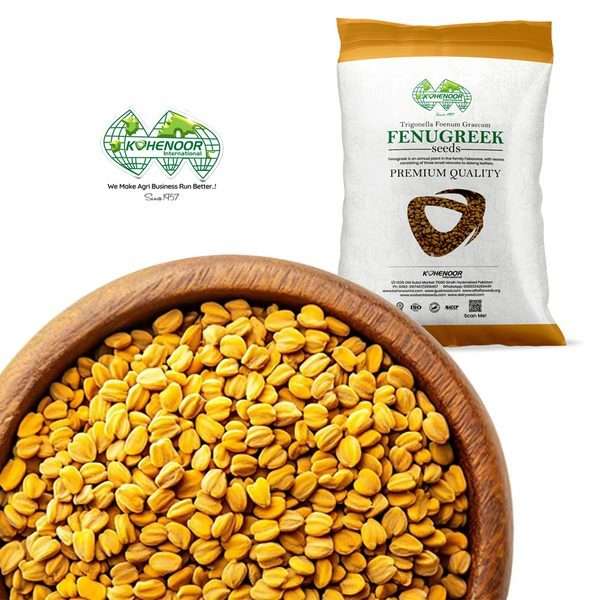
Kohenoor International has exported fenugreek from Sindh and Punjab since 1957. Country-specific import pages are available for Ireland, the United Kingdom, Sweden, Denmark, the Netherlands, Germany, Belgium, France, the USA and Canada.
Why Fenugreek Ends Up in So Many Horse Feeds
Horses are selective eaters, and a feed that is refused is a feed that fails. Fenugreek’s aroma comes largely from sotolon, the same compound that gives maple syrup and curry their warm, sweet note, and it carries through pelleting, extrusion and micronising well. That is why formulators use it in three main ways:
- Palatability and appetite: a small inclusion masks the taste of minerals, vitamins, oils and medicated or bitter ingredients, and encourages fussy or stressed horses to clear the bucket.
- Condition and topline products: fenugreek is commonly combined with linseed, alfalfa, soya and oils in products aimed at weight and coat condition. The seed itself contains roughly 23-28% protein, 6-8% oil and a high share of soluble fibre (galactomannan gum) — typical values; your CoA gives the lot figures.
- Straight “herb” sales: many equine retailers sell whole or ground fenugreek in 1-20 kg tubs and bags as a straight feed additive, a high-margin line for brands that pack their own labels.
Any health or performance claims on the finished product are the brand’s responsibility and must comply with local feed-labelling law; Kohenoor supplies the raw material with its analytical data, not claims.
What to Specify When You Buy Fenugreek for Feed
Feed-grade and food-grade fenugreek come from the same crop; what differs is the cleaning, the testing and the paperwork. For equine use most buyers now specify food-grade cleaning with feed-law documentation, because horses are both animals and, in the EU, potential food-producing animals.
| Parameter | Typical feed-mill specification | Kohenoor export standard |
|---|---|---|
| Botanical name | Trigonella foenum-graecum L. | Trigonella foenum-graecum L., Pakistan origin |
| Form | Whole seed (milled at destination) or kibbled | Whole seed, Bold and Regular grades |
| Purity | 98-99% min | 99.5% min, sortex-cleaned and de-stoned |
| Moisture | ≤12% | ≤10% |
| Admixture / foreign matter | ≤1% | ≤0.5% |
| Aflatoxin B1 | Below feed limit (EU 0.02 mg/kg feed material at 12% moisture) | Lab-tested per lot, result on the CoA |
| Pesticide residues | Multi-residue screen | Tested per lot against EU Reg. (EC) 396/2005 panel |
| Ethylene oxide | Not detected / below LOQ | Tested per lot (ETO + 2-chloroethanol) |
| Salmonella | Absent in 25 g | Tested per lot; steam-sterilised lots on request |
| Packing | 25 kg bags or 1 MT big bags | 25/50 kg PP or paper bags, 1 MT big bags, private label |
| HS code | 0910.99 | 0910.99 |
Three points trip up first-time feed buyers:
- Ask for aroma consistency, not just purity. Aroma varies with crop year and storage. Approve a reference sample, keep it, and require that shipment samples match it. We retain a counter-sample of every lot.
- Specify whole seed and mill it yourself. Ground fenugreek loses aroma quickly and is harder to test for adulteration. Most mills buy whole seed and grind or micronise it close to use.
- Put the mycotoxin and microbiology results in the contract. The contract should say “CoA per lot from an accredited laboratory” and name the parameters. That protects both sides.
Feed-Law Paperwork by Market
European Union (Ireland, Sweden, Denmark, Netherlands, Germany, Belgium, France)
Fenugreek seed destined for animal feed is a feed material. The importer must be a registered feed business operator under the Feed Hygiene Regulation (EC) 183/2005 and label the material in line with the feed marketing Regulation (EC) 767/2009; the EU Catalogue of feed materials (Reg. (EU) 68/2013) is the usual reference for naming. Undesirable-substance limits, including aflatoxin B1, come from Directive 2002/32/EC. Plant-origin consignments need a phytosanitary certificate, and if fenugreek from Pakistan appears in the current annex of Implementing Regulation (EU) 2019/1793, the lot must be pre-notified in TRACES NT and may be sampled at the border control post. Most Irish, Scandinavian and Dutch equine mills also require GMP+ or FEMAS-style supplier approval — we complete supplier questionnaires and provide HACCP and ISO 9001:2015 certificates on request.
Practical routes: Irish mills usually land via Dublin or via a UK or Rotterdam hub; Swedish and Danish buyers via Gothenburg, Aarhus or Hamburg; Dutch and Belgian buyers via Rotterdam and Antwerp. See the Ireland, Sweden, Denmark and Netherlands guides for port tables and transit times.
United Kingdom
Great Britain retains the EU feed rules in domestic law. The importer must be registered with its local authority as a feed business, and plant-product consignments are pre-notified through IPAFFS. Many British equine brands also require UFAS or BETA NOPS assurance within their own supply chain; the raw-material supplier’s role is to provide the CoA, traceability and a completed supplier questionnaire. Details and ports (Felixstowe, Southampton, London Gateway, Liverpool) are on the UK fenugreek page.
Competition horses: prohibited-substance risk
Fenugreek itself is a common feed ingredient, but every competition-horse feed brand manages the risk of cross-contamination with naturally occurring prohibited substances (NOPS) such as caffeine, theobromine or morphine from other crops. The protection is supply-chain discipline: dedicated cleaning lines, no shared storage with cocoa or coffee products, and lot-level traceability. Ask your supplier how the seed is cleaned and stored, and test finished feeds under your own NOPS programme. Rules change — always check the current FEI and national federation lists with your veterinarian.
United States and Canada
In the USA, fenugreek entering the feed channel falls under FDA’s animal-food rules: the foreign facility must be FDA-registered, each shipment needs Prior Notice, and the importer maintains a Foreign Supplier Verification Program file; state feed-control officials (AAFCO model rules) govern the finished label. In Canada, the Feeds Regulations administered by the CFIA apply to the finished feed, while imports of plant products follow AIRS conditions. The USA and Canada pages cover ports and documents; the fenugreek import requirements checklist has the full food-side detail.
Buying in Bulk: Volumes, Packing and Timing
| Buyer type | Typical annual volume | Usual order pattern | Packing |
|---|---|---|---|
| Regional equine feed mill | 10-60 MT | 2-4 × 20′ containers a year, or mixed containers | 1 MT big bags |
| National equine brand | 40-200 MT | Annual contract, monthly or quarterly call-offs | 25 kg paper bags or big bags |
| Supplement / herb brand | 3-20 MT | 500 kg trial, then 5-10 MT lots | 25 kg bags, private label on request |
| Feed distributor / trader | 20-100 MT | Spot plus forward contracts | 25/50 kg bags |
A 20-foot container carries 18-20 MT of fenugreek in 25 or 50 kg bags. Buyers with smaller needs often combine fenugreek with linseed, fennel, sesame or alfalfa seed in one container to reach full-load freight rates. Our MOQ is 1 MT, with 500 kg trial lots and free samples for laboratory approval.
Timing: Pakistan’s fenugreek harvest runs March to May. New-crop pricing is normally set by June, and the best time to fix an annual contract for equine feed is June-September, before the northern-hemisphere autumn and winter feeding season drives demand. Shelf life of properly stored whole seed is 24 months.
How to Control Landed Cost
- Buy FOB Karachi and use your own forwarder if you already import other ingredients from South Asia; otherwise ask for a CFR or CIF quotation to your port.
- Fix price for the season with scheduled shipments. Fenugreek is a small crop and prices move with Indian and Pakistani harvest reports; forward contracts protect your feed margin.
- Consolidate testing: agree on one accredited laboratory for the CoA (SGS, Intertek or Bureau Veritas) and accept its results, rather than paying for duplicate testing at both ends.
- Pack for your process: big bags are cheaper per tonne and faster to tip; paper bags suit retail repacking.
- Combine documents: one phytosanitary certificate, CoA, certificate of origin, invoice and packing list per container keeps clearance fast at Dublin, Rotterdam or Felixstowe.
Supplier Checklist for Equine Buyers
- Reference sample approved and retained (aroma, colour, size).
- CoA per lot: purity, moisture, admixture, aflatoxin B1/total, pesticide screen, ethylene oxide, Salmonella.
- Phytosanitary certificate and certificate of origin.
- Supplier questionnaire completed; ISO 9001:2015 and HACCP certificates on file.
- Traceability from lot number back to growing district and cleaning date.
- Storage and cleaning controls documented for NOPS risk.
- Packing, labelling and palletisation agreed in writing.
- Incoterm, payment terms and shipment schedule agreed.
Buy Feed-Grade Fenugreek Direct from Origin
Sortex-cleaned 99.5% whole fenugreek seed, moisture ≤10%, tested per lot for aflatoxin, pesticide residues, ethylene oxide and Salmonella with a CoA. 1 MT MOQ, 500 kg trial lots, free samples, 25/50 kg bags or 1 MT big bags, FOB Karachi / CFR / CIF. ISO 9001:2015 + HACCP, exporting since 1957 to 70+ countries. See the fenugreek seed product page or ask for a quotation.
Request a Quote →Frequently Asked Questions
Is fenugreek safe to use in horse feed?
Fenugreek seed is a long-established ingredient in commercial horse feeds and supplements, used mainly for palatability. The inclusion rate and any claims on the finished product are decided by the brand’s nutritionist and must comply with local feed law; Kohenoor supplies the raw seed with lot-level analytical data.
Should a feed mill buy whole or ground fenugreek?
Whole seed. Ground fenugreek loses aroma quickly, is harder to verify for adulteration and costs more to ship safely. Most mills grind or micronise whole seed shortly before use.
What aflatoxin limit applies to fenugreek used as a feed material in the EU?
Directive 2002/32/EC sets 0.02 mg/kg aflatoxin B1 for feed materials at 12% moisture. Kohenoor tests aflatoxin B1 and total aflatoxins on every export lot and reports the result on the Certificate of Analysis.
What is the minimum order for feed-grade fenugreek?
1 MT, with 500 kg trial lots and free samples for laboratory approval. A 20-foot container holds 18-20 MT, and fenugreek can be combined with linseed, fennel, sesame or alfalfa seed in one container.
When is the best time to contract fenugreek for the winter feeding season?
Pakistan harvests fenugreek in March-May. Fixing an annual contract between June and September secures new-crop quality and price before autumn and winter demand from equine feed mills.
Can you pack fenugreek under our own brand?
Yes. Private-label 25 kg bags are available, and big bags can carry your lot-coding format. Artwork and label wording are supplied by the buyer.