The Short Version
A fenugreek specification sheet is the contract in miniature. It tells a buyer what the seed should look like, how clean and dry it must be, which contaminants have been tested and against which limits, and which functional components (saponins, galactomannan, protein) matter for the buyer’s end use. A Certificate of Analysis (CoA) is the matching report for one physical lot. Most disputes in the fenugreek trade come from buyers and sellers reading those two documents differently — agreeing on “99% purity” without agreeing on how it is measured, or accepting a CoA that never tested ethylene oxide. This guide walks through each line of a professional fenugreek spec sheet, explains what the number means, what a sensible commercial value is, and which parameters matter for spice blenders, feed mills, sprouting-seed packers and extraction plants.
Kohenoor International has exported fenugreek from Pakistan since 1957, and ships sortex-cleaned whole seed to buyers in Germany, the Netherlands, the UK, France, Poland, the USA, Canada and Brazil. The values below are typical commercial standards and our own export specification; your CoA states the figures for each lot.
Part 1: Identity and Physical Description
The top of every spec sheet identifies the product. It sounds trivial, but customs, food-safety and feed authorities read this first, and a mismatch between the spec, the invoice and the phytosanitary certificate is one of the commonest causes of border delays.
- Botanical name: Trigonella foenum-graecum L. Always the full Latin name, which avoids confusion between local names such as methi, Bockshornklee, fenugrec, fieno greco, alholva or feno-grego.
- Part and form: whole dried seed. Ground, kibbled, roasted or sterilised forms need their own specifications because moisture, microbiology and shelf life change.
- Origin: country and, ideally, growing region. Pakistani fenugreek is grown mainly in Sindh and Punjab and harvested March to May.
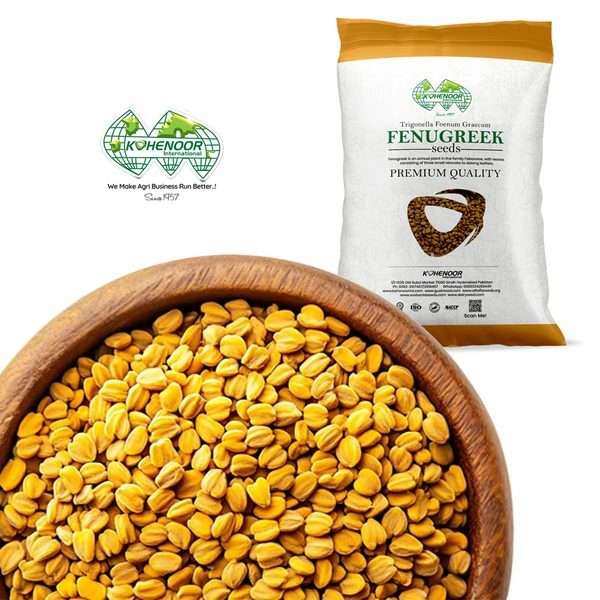
- Appearance: golden-yellow to amber, angular, hard seeds about 3-5 mm long, with the characteristic deep furrow.
- Odour and taste: strong, warm, maple-like aroma (from sotolon) and a bitter taste; free from musty, mouldy or foreign odours. Approve and retain a reference sample, because aroma is the parameter most often disputed.
- HS code: 0910.99 for fenugreek seed traded as a spice; buyers should confirm the national tariff line in their own customs system.
Part 2: Cleanliness — Purity, Admixture and Foreign Matter
Cleanliness parameters describe what else is in the bag besides sound fenugreek seed. They are measured by hand-sorting a weighed sample and are the parameters most affected by cleaning technology. Sortex (optical colour sorting) after gravity tabling and de-stoning is what moves Pakistani fenugreek from 98% to 99.5% purity.
| Parameter | What it measures | Typical commercial value | Kohenoor export standard |
|---|---|---|---|
| Purity | Sound fenugreek seed as % of sample weight | 98-99% min | 99.5% min, sortex-cleaned |
| Admixture / foreign matter | Stones, soil, stems, chaff, other seeds | ≤1% | ≤0.5% |
| Extraneous matter (ASTA-style) | Insect fragments, excreta, mould | Per buyer cleanliness spec | Meets EU/US spice buyer requirements on request |
| Broken, shrivelled, immature seed | Damaged fenugreek seed | ≤2-3% | Minimised by sortex; stated on CoA |
| Live insects | Infestation at loading | Absent | Absent; fumigated where required by importing country |
Two points matter more than the headline number. First, agree how purity is measured: sample size, whether broken seed counts as impurity, and whether other Trigonella or legume seeds count as admixture. Second, for buyers in the EU and UK the presence of weed seeds such as Datura or Ambrosia is a food- and feed-safety question, not just a cleanliness question, so ask for them to be reported separately.
Part 3: Moisture, Ash and Storage Stability
Moisture is the single most important parameter for a sea shipment. Fenugreek dried to 10% or below stores well for 24 months in cool, dry conditions; above about 12% the risk of mould, caking and mycotoxin formation rises sharply during a three- to six-week voyage through warm seas. We specify ≤10% and recommend that buyers test on arrival with the same method (oven-drying to ISO or AOAC procedure) used for the CoA, because rapid moisture meters can read one to two points differently.
Total ash measures mineral content after incineration; acid-insoluble ash measures sand and soil. Total ash for clean fenugreek typically sits around 3-5%, and acid-insoluble ash should be low (often specified at 1% or less). A high acid-insoluble ash figure is a quick signal of poor cleaning or adulteration with soil, which is why EU and US spice buyers include it even when purity looks good.
Part 4: Food-Safety Contaminants
This section decides whether a lot can legally enter the destination market. Each parameter should name the method, the laboratory and the limit it is judged against.
- Aflatoxins (B1 and total B1+B2+G1+G2): the EU sets maximum levels for aflatoxins in spices, and the same family of limits applies in the UK; feed materials are covered by Directive 2002/32/EC. We test aflatoxin B1 and total aflatoxins per lot and report the result on the CoA. See our import requirements checklist for market-by-market rules.
- Ochratoxin A: commonly requested by EU spice buyers; included on request.
- Pesticide residues: a multi-residue screen (often 400-500 compounds by LC-MS/MS and GC-MS/MS) judged against the destination MRLs — EU Regulation (EC) 396/2005 for the EU, the US EPA tolerances under 40 CFR Part 180 for the USA, and so on.
- Ethylene oxide and 2-chloroethanol: ETO is not permitted for treating food in the EU, and residues triggered major spice recalls in 2020-2022. Every Kohenoor lot is tested for ETO (expressed as the sum of ETO and 2-chloroethanol) and our seed is not treated with ETO.
- Microbiology: Salmonella absent in 25 g is the universal requirement; spice buyers often add total plate count, yeasts and moulds, E. coli and Bacillus cereus. Steam-sterilised lots can be arranged where the buyer’s process requires low counts.
- Heavy metals: lead, cadmium, arsenic and mercury are increasingly requested by nutraceutical and baby-food supply chains.
The rule we apply, and recommend to buyers, is simple: a lot is tested per lot and supplied with a CoA. No responsible supplier can promise that every future lot is “guaranteed below limits”; what protects both sides is a named accredited laboratory (SGS, Intertek, Bureau Veritas or the buyer’s nominee), a stated method and a retained counter-sample.
Part 5: Functional and Compositional Parameters
These parameters are not about safety; they describe what the seed will do in the buyer’s product. Most spice blenders never specify them. Extraction plants, gum producers and nutraceutical brands always do.
Saponins and diosgenin
Fenugreek seed is rich in steroidal saponins. After acid hydrolysis these release diosgenin, a sapogenin that pharmaceutical and nutraceutical processors use as a starting material and as a marker compound for standardised extracts. Published values for diosgenin in fenugreek seed are commonly reported in the region of a few tenths of one percent up to about one percent, depending on variety, growing conditions and analytical method. Because the content is driven by crop and season, an extraction buyer should specify a minimum value, agree the HPLC or HPTLC method, and approve lots on pre-shipment samples. We supply lot-specific analysis on request rather than a fixed guarantee.
Galactomannan (fenugreek gum)
The seed endosperm stores a soluble galactomannan gum with a high galactose-to-mannose ratio, which is why soaked fenugreek becomes mucilaginous. Gum, thickener and dietary-fibre manufacturers extract it; literature values for galactomannan or total soluble fibre in whole seed commonly fall in the 20-30% range. Specify the method (for example, soluble dietary fibre by AOAC) and whether results are on an as-is or dry-matter basis.
Protein, fat and fibre
Whole fenugreek seed typically contains around 23-28% protein, 6-8% fat and a high total dietary fibre content. Feed mills formulating equine and livestock feeds may ask for a proximate analysis (protein, fat, fibre, ash, moisture) to load the ingredient into their formulation software. These are typical values; your CoA gives the lot figures.
Which Lines Matter for Your End Use?
| Buyer type | Must-have parameters | Often added |
|---|---|---|
| Spice blenders & curry powder makers | Purity, moisture, aroma, aflatoxins, pesticides, ETO, Salmonella | Acid-insoluble ash, ochratoxin A, TPC, steam sterilisation |
| Feed mills & equine brands | Purity, moisture, aflatoxin B1 (feed limit), pesticides, Salmonella | Proximate analysis, weed-seed screen, GMP+/FEMAS questionnaire |
| Sprouting & microgreen packers | Germination, Salmonella, E. coli (including STEC), no seed treatment | Lot traceability to field, dedicated clean lots |
| Extraction & nutraceutical plants | Diosgenin or saponin minimum, moisture, pesticides, heavy metals | Botanical identity (HPTLC fingerprint), residual solvents in extract |
| Gum & fibre manufacturers | Galactomannan or soluble fibre, protein, moisture | Viscosity of extracted gum, colour |
Kohenoor Fenugreek Export Specification at a Glance
| Parameter | Specification |
|---|---|
| Product | Whole fenugreek seed, Trigonella foenum-graecum L., Pakistan origin, Bold and Regular grades |
| Purity | 99.5% minimum, sortex-cleaned and de-stoned |
| Moisture | ≤10% |
| Admixture | ≤0.5% |
| Contaminant testing | EU-MRL (Reg. 396/2005) pesticide screen, ethylene oxide, aflatoxins and Salmonella tested per lot, CoA supplied |
| Harvest / shelf life | March-May harvest; 24 months in cool, dry storage |
| Packing | 25 kg or 50 kg bags, 1 MT big bags, private label on request |
| MOQ | 1 MT; 500 kg trial lots; free samples |
| Incoterms | FOB Karachi / CFR / CIF |
| HS code | 0910.99 |
Five Mistakes Buyers Make With Fenugreek Spec Sheets
- Accepting a generic spec sheet instead of a lot CoA. A spec sheet is a promise; the CoA is evidence. Insist on the CoA number on the invoice.
- Not naming the laboratory and method. Two labs can differ on moisture or aflatoxin. Name one accredited lab and accept its result as final, with a retained counter-sample for referee testing.
- Forgetting ethylene oxide. ETO is not part of every standard pesticide screen. Ask for it by name.
- Specifying functional parameters you do not need. Diosgenin or galactomannan minimums add cost and narrow supply. Specify them only if your process depends on them.
- Ignoring aroma. Purity can be perfect and aroma flat. Approve a reference sample and require shipments to match it.
Get a Fenugreek Spec Sheet and Sample From Origin
Sortex-cleaned 99.5% whole fenugreek seed, moisture ≤10%, admixture ≤0.5%, tested per lot for aflatoxins, pesticide residues (EU MRL panel), ethylene oxide and Salmonella with a CoA. Lot-specific saponin, diosgenin or proximate analysis on request. 1 MT MOQ, 500 kg trial lots, free samples, FOB Karachi / CFR / CIF. ISO 9001:2015 + HACCP, exporting since 1957 to 70+ countries. See the fenugreek seed product page or ask for a quotation.
Request a Quote →Frequently Asked Questions
What purity should I specify for export-grade fenugreek seed?
For spice, food and feed use, 99.5% minimum purity after sortex cleaning is a strong commercial standard; many buyers accept 99%. Purity is measured by weight after removing foreign matter, other seeds, broken and shrivelled seed. Kohenoor ships 99.5% minimum with admixture of 0.5% or less.
What moisture level is safe for fenugreek seed in a container?
10% or lower. Fenugreek above roughly 12% moisture is at higher risk of mould growth, caking and mycotoxin formation during a 3-6 week sea voyage, especially when containers cross warm seas. Kohenoor dries and ships at 10% moisture or below.
What do saponin and diosgenin figures on a fenugreek CoA mean?
Fenugreek seed contains steroidal saponins, and diosgenin is the aglycone usually measured after hydrolysis. Extraction and nutraceutical buyers specify a minimum diosgenin or total saponin content; spice and feed buyers usually do not. The figure varies by crop and variety, so it is quoted per lot on request rather than guaranteed in a standard contract.
What is galactomannan in fenugreek and who needs it?
Galactomannan is the soluble gum stored in the seed endosperm and gives fenugreek its thickening and fibre value. Gum and fibre-ingredient manufacturers specify it, often with protein and fat; for spice and feed use it is not normally a contract parameter.
Which tests should be on every fenugreek Certificate of Analysis?
At minimum: purity, moisture, admixture or foreign matter, aflatoxin B1 and total aflatoxins, a multi-residue pesticide screen against the destination MRLs, ethylene oxide (with 2-chloroethanol) and Salmonella. Ochratoxin A, heavy metals, total ash and acid-insoluble ash are common additions for EU and US spice buyers.