The Short Version
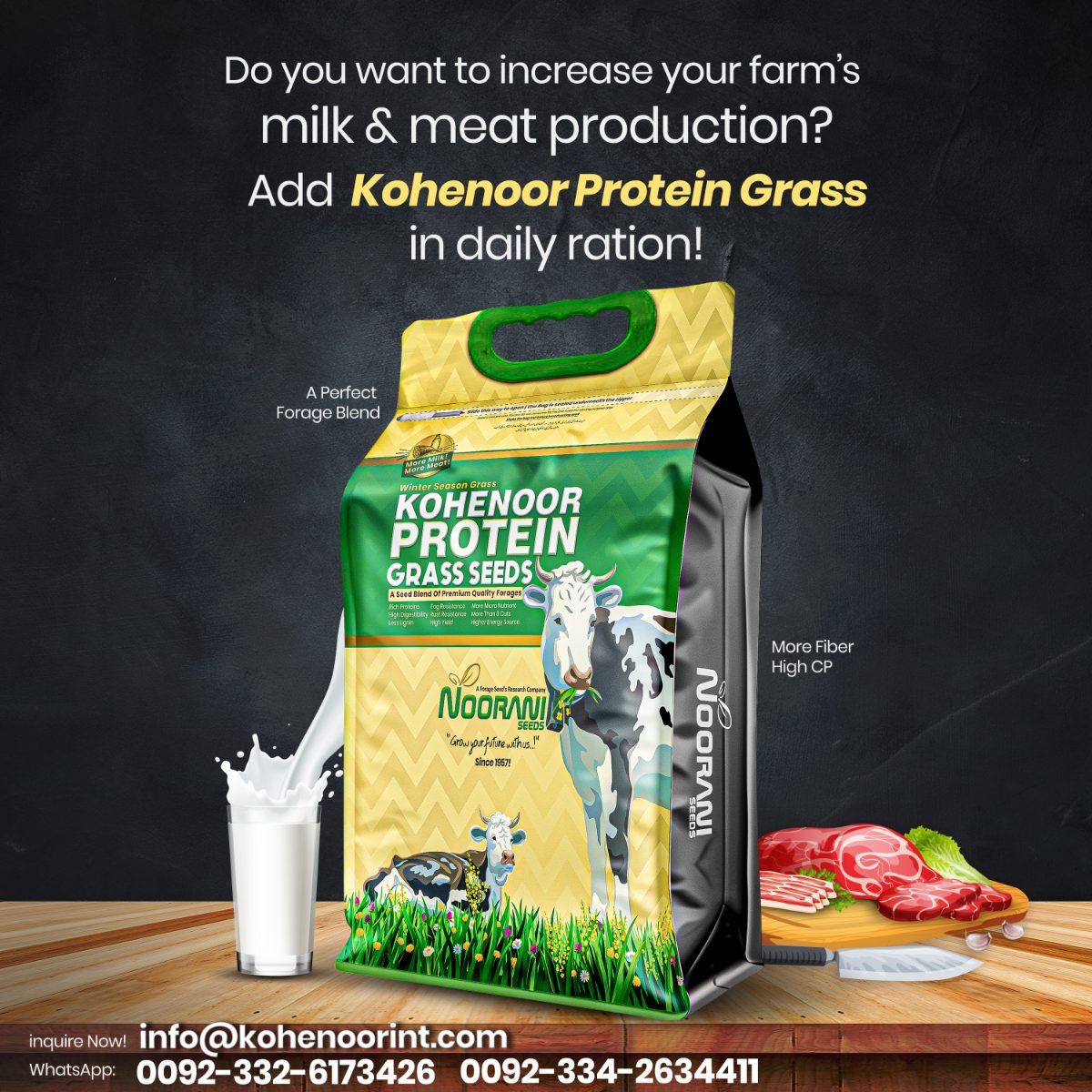
Napier grass is the backbone of zero-grazing in Kenya, Uganda, Tanzania and Ethiopia: it produces a lot of green bulk from canes planted once. But bulk is not milk. Napier’s crude protein is typically 8-12% and falls quickly as the stems harden, which is why most smallholders still buy dairy meal to keep yields up. Kohenoor Protein Grass is built for the opposite job: a proprietary, high-protein fodder seed with 26-38% crude protein, first cut at 45 days and then every 20-25 days. Farmers using it report +2-5 kg of milk per cow per day within 20-25 days and roughly 50% less concentrate. Our slogan is on every bag: More Milk, More Meat.
The best answer for most East African dairy farms is not “either / or”. It is Napier for bulk, Protein Grass for protein — and cutting the dairy-meal bill that eats most of the milk cheque. Country buyer guides: Kenya, Uganda, Tanzania, Ethiopia and South Africa.
Side-by-Side Comparison
| Factor | Napier grass | Kohenoor Protein Grass |
|---|---|---|
| What it is | Tall perennial grass (Pennisetum purpureum), planted from canes or root splits | Proprietary high-protein fodder seed, sown from seed; formulation is proprietary |
| Crude protein | Typically 8-12%, lower when over-mature | 26-38% (stated on the Certificate of Analysis) |
| Crude fibre | High, rising sharply with stem age | ≤26% |
| Minerals / dry matter | Variable | Minerals ~10%, dry matter ~45% |
| Establishment | Labour-heavy cane planting; 3-4 months to first cut | Seed drill or broadcast, 10 kg/acre (25 kg/ha); first cut at 45 days |
| Cutting interval | Every 6-8 weeks at about 1 m height | Every 20-25 days, cut 10 cm above ground, 5-10 cuts per season |
| Fresh yield | High bulk per year | About 10-12 t fresh per acre per cut |
| Best season | Warm, wet conditions; all year under irrigation | Cool season — sow when daytime temperature is ≤28°C (highlands, long-rains-to-cool-season windows) |
| Main risk | Napier stunt disease and head smut in parts of East Africa; low protein when cut late | Needs good seedbed, DAP at sowing and urea after each cut |
| Main job on the farm | Bulk and fibre | Protein — replaces much of the dairy meal |
Why Protein, Not Bulk, Limits Milk on Most Smallholdings
A Friesian or Ayrshire cow producing 15-20 litres needs a diet of roughly 14-16% crude protein. Napier alone cannot deliver that, so the gap is filled with dairy meal, cotton-seed cake or sunflower cake — bought feeds whose prices in Nairobi, Kampala, Arusha and Addis Ababa have risen sharply in recent years. When the protein gap is not filled, the cow eats plenty but milks poorly. That is the pattern extension officers see across the Rift Valley, central Kenya, south-western Uganda and the Tanzanian highlands: full feed troughs, flat milk records.
Kohenoor Protein Grass closes that gap on the farm. Because it is cut young and often, the forage stays leafy and high in protein all season. Fed alongside Napier, maize stover or hay, it lifts the protein of the whole ration, and farmers report the milk response within three weeks.
What the Numbers Mean for a 5-Cow Zero-Grazing Unit
| Item | Napier + dairy meal | Napier + Protein Grass + half the meal |
|---|---|---|
| Milk per cow per day | Baseline | Baseline + 2-5 kg (farmer-reported) |
| Extra milk, 5 cows × 30 days | — | 300-750 litres per month |
| Dairy meal purchased | 100% | About 50% |
| Land for Protein Grass | — | About 0.5-1 acre (5-10 kg of seed) |
Multiply the extra litres by your local farm-gate price and add the dairy-meal saving: for most farms the seed and fertiliser cost is recovered in the first month of feeding. Results depend on breed, management and weather, and Kohenoor states performance on the Certificate of Analysis rather than promising a fixed number.
When to Grow Napier, When to Grow Protein Grass
- Keep Napier on boundaries, steep land and the parts of the farm that need a perennial, low-maintenance bulk crop. Cut it at about 1 m for the best quality.
- Add Protein Grass on your best, most accessible plot near the cow shed, sown at the start of a cool season (daytime ≤28°C). In Kenya’s highlands (Nyandarua, Nakuru, Kiambu, Meru, Uasin Gishu), Uganda’s south-west (Mbarara, Kiruhura), Tanzania’s Kilimanjaro and Southern Highlands, and the Ethiopian highlands, that window is wide.
- Replace Napier where head smut or stunt disease has wiped out stands: re-establish clean Napier canes for bulk, and use Protein Grass to rebuild protein quickly while the new Napier grows.
- For fattening of bulls, steers, sheep and goats, Protein Grass supports 700-800 g/day live-weight gain in fattening cattle, as reported by farmers — the “More Meat” half of the slogan.
A Year-Round Feeding Plan for Highland Dairy Farms
The two crops complement each other through the seasons. A simple plan used by many zero-grazing units looks like this:
| Period | Napier | Protein Grass | Bought feed |
|---|---|---|---|
| Long rains | Rapid regrowth — cut at 1 m, surplus into silage | Sow at the start of the cool spell; first cut at 45 days | Reduce dairy meal as Protein Grass comes in |
| Cool season | Slower growth, still main bulk | Peak: cut every 20-25 days, feed fresh or wilted | About half the usual meal |
| Short rains | Second flush — conserve surplus | Continue cuts while temperatures allow; ensile surplus | Adjust to milk records |
| Dry season | Stored silage, stover | Protein Grass silage from earlier cuts | Top up only as needed |
Ensiling surplus Protein Grass from the cool season is the cheapest way to carry protein into the dry months, when Napier is short and dairy-meal prices usually peak.
Five Mistakes That Cost Milk
- Cutting Napier too late. Napier cut at two metres is mostly stem. Cut at about one metre for leafier, better feed.
- Relying on bulk alone. A full trough of low-protein feed keeps cows busy, not productive. Balance protein first.
- Sowing Protein Grass in the hottest weeks. It is a cool-season fodder; sow when daytime temperatures are at or below 28°C.
- Skipping fertiliser after cutting. Urea after each cut is what keeps the 20-25-day regrowth cycle going for 5-10 cuts.
- Changing the ration overnight. Introduce any new forage over 7-10 days and watch the milk records, not the feed trough.
For Distributors, Co-operatives and NGOs
Agro-dealers and dairy co-operatives in Kenya, Uganda, Tanzania and Ethiopia can stock Kohenoor Protein Grass in farmer-sized 5 and 10 kg packs, with 25 kg bags for larger farms and demonstration plots. We support distributors with the “More Milk, More Meat” bag artwork, sowing instructions for farmer days and a Certificate of Analysis for every lot, and we can plan shipments ahead of each planting window. Development projects and processors running milk-collection schemes use Protein Grass in farmer-training packages because the milk response is fast enough for farmers to see within one cutting cycle.
How to Establish Kohenoor Protein Grass
- Prepare a fine, firm seedbed; remove weeds.
- Apply DAP at 50 kg per acre at sowing.
- Sow 10 kg per acre (25 kg/ha); on light soils use 12-15 kg per acre.
- Take the first cut at 45 days, 10 cm above the ground.
- Top-dress with urea after each cut; cut again every 20-25 days for 5-10 cuts.
- Feed fresh, wilted or as silage alongside Napier or other roughage.
Seed is supplied with purity 98%+, germination 85%+ and moisture ≤12%, in 5, 10 and 25 kg packs; MOQ for importers and distributors is 500 kg, HS 1209.29.
Buying Protein Grass Seed in East Africa
Kohenoor International ships from Karachi to Mombasa (Kenya, Uganda via the Northern Corridor), Dar es Salaam (Tanzania, Southern Highlands) and Djibouti (Ethiopia), with a phytosanitary certificate, Certificate of Analysis, ISTA-method germination result and certificate of origin. Distributors, dairy co-operatives, NGOs and agro-dealers can order from 500 kg; each country page explains the seed-import permit and the regulator involved (KEPHIS in Kenya, MAAIF in Uganda, TPHPA/TOSCI in Tanzania, the Ministry of Agriculture in Ethiopia). See also our guide to importing seeds from Pakistan and the alfalfa vs berseem clover comparison for other forage options.
Muhtasari kwa Kiswahili
Kohenoor Protein Grass dhidi ya Napier: Napier hutoa wingi wa malisho lakini protini yake ni kati ya 8-12% tu. Kohenoor Protein Grass ina protini 26-38%, hukatwa mara ya kwanza baada ya siku 45 na kisha kila siku 20-25. Wafugaji wanaripoti maziwa zaidi kilo 2-5 kwa ng’ombe kwa siku ndani ya siku 20-25 na kupunguza chakula cha dukani (dairy meal) kwa takriban nusu. Tumia Napier kwa wingi na Protein Grass kwa protini. Panda kilo 10 kwa ekari wakati joto la mchana ni chini ya 28°C. Maziwa Zaidi, Nyama Zaidi. Wasiliana nasi kwa WhatsApp +92 310 4929292 au export@kohenoorint.com.
More Milk, More Meat — Order Kohenoor Protein Grass
26-38% crude protein, first cut in 45 days, then every 20-25 days. Packs of 5, 10 and 25 kg; 500 kg MOQ for distributors and co-operatives; shipped from Karachi to Mombasa, Dar es Salaam and Djibouti with full documents. See the Kohenoor Protein Grass page or ask for a quotation.
Request a Quote →Frequently Asked Questions
Does Kohenoor Protein Grass replace Napier?
Not usually. Napier is a low-cost perennial source of bulk; Protein Grass is a high-protein fodder cut every 20-25 days. Most dairy farms get the best result by keeping Napier for bulk and using Protein Grass to replace roughly half of the purchased dairy meal.
How much more milk can I expect?
Farmers report an increase of 2-5 kg of milk per cow per day within 20-25 days of feeding. Actual results depend on breed, ration and management; Kohenoor states product performance on the Certificate of Analysis.
What is the crude protein of Napier compared with Protein Grass?
Napier is typically 8-12% crude protein and falls as it matures. Kohenoor Protein Grass is 26-38% crude protein with crude fibre at or below 26%.
When should Protein Grass be sown in Kenya, Uganda or Tanzania?
At the start of a cool period when daytime temperatures are at or below 28°C, which in the highlands covers much of the year. Sow 10 kg per acre with 50 kg DAP, take the first cut at 45 days and top-dress with urea after each cut.
What is in the Protein Grass blend?
The formulation is proprietary. Kohenoor sells Protein Grass on its outcome — More Milk, More Meat — with the nutritional and seed-quality figures stated on the Certificate of Analysis.
What is the minimum order for importers and co-operatives?
500 kg, packed in 5, 10 or 25 kg bags, shipped from Karachi to Mombasa, Dar es Salaam or Djibouti with phytosanitary certificate, Certificate of Analysis and certificate of origin.